I listen to a lot of podcasts and I thought I was pretty regular in making recommendations. Evidently not. Here’s my current list with comments:
1A (Weekly news roundup): Weekly commentary on political and international news reported in mainline US media. The host Joshua Johnson brings both an interesting perspective and an interesting set of commenters to it. Johnson is leaving, so this is on the bubble.
99% Invisible: Roman Mars orchestrates this discussion of the good and bad design that shapes and has shaped our world. It’s a Radiotopia production. I usually learn something and always enjoy it.
A Way With Words: These folks do an excellent podcast about language origins, evolution, and usage. I like that they are descriptiveist and inclusive, which is to say they document English as it’s used including dialects often considered ungrammatical and lowbrow. They’re both professional linguists as well. Great fun.
Historcial Blindness: Nathaniel Lloyd conducts this tour through the fortean and unusual areas of history with a skeptic’s eye. His delivery can be a little dry, but I find the content is more than captivating.
Awesome Etiquette: I’ve talked up these folks before, and I will again. They advocate for and apply a version of etiquette based on three principles of quality human relations. Their family business is the Emily Post publishing and training endeavors, so they have the chops to tell you which fork to use and why, but that’s rarely the focus. One of my favorites.
Baseball Tonight Podcast: I love the rhythms of a baseball play-by-play radio broadcast. Buster Olney and company keep those rhythms in this daily MLB summary. Good for baseball fans.
Bombshell: These folks are my favorite accessible foreign policy experts. I always learn something when I listen to them and I never get bored. In foreign policy, that’s an unbelievable combination. Check them out if you care about foreign policy.
Code Switch: This is an NPR podcast about race in America. The hosts and reporters bring broad perspectives and great reporting skills to the beat. It’s often informative both about the issues the report on and on the constraints of reporting on them for a large news outlet. High variability, but generally very strong.
Conversations With People Who Hate Me: Dylan Marron calls people who left him nasty comments on his social media accounts and talks through how that came to happen. This is not an ambush, but a collaboration between both folks on the line. In addition, one can easily find Dylan himself grating. He strikes me as what stereotypical conservatives think a stereotypical liberal sounds like. I think he’s more interesting than that, but your mileage may vary.
Desert Oracle Radio: Key Layne remains a fascinating and poetic preacher of the weird and marginalized who strikes a unique balance the mystical and the skeptical. Listen to two and you’ll know if it’s for you. It’s for me.
Dolly Parton’s America: Jad Abumrad and some of the other talented folks at WNYC and RadioLab talk about and with country star and current media darling Dolly Parton. They do an excellent job both illuminating her as a person and as a lens to look at America. Limited series, and worth it.
Deep State Radio: Another foreign policy podcast. The flagship is intended to be a cocktail party atmosphere where experts are chatting. I generally find it a bit more staged and biased than that aspiration. It’s largely redeemed in my ears by regulars Rosa Brooks and Kori Schake who often rise above the politics of the day to re-enforce the key principles behind internationalism.
Art And Ideas: The Getty Museum puts this regular discussion with the Getty conservation and museum staff. Most are driven by exhibitions that at the Getty, but I find them informative. If you’re near the Getty these may well draw you up to see those shows. As a guilty pleasure I enjoy listening to host Jim Cuno as he grows as an interviewer and host.
Golic and Wingo: ESPN’s flagship sports talk podcast. I listen to keep up enough to converse. It is fun as a radio show as well, in a Disney/ESPN kind of way. Mike Golic, Jr. and the Sorry In Advance podcast are high points for me.
Good Christian Fun: A look at faith and spirituality through the lens of evangelical-targeted media (music, movies, etc). I’ve learned a lot about Evangelical culture and niche media as well as hearing from some extremely talented rising entertainers. As interesting as all that is, it works because the hosts – Kevin T. Porter and Caroline Ely – are honest, enthusiastic, open, and bold. It’s a strong flavor and it won’t appeal to everyone. I won’t miss an episode.
Here Be Monsters: This is one of my favorites. The hosts peer into frightening and unknown themes. Surprising, intimate, and often harrowing.
History Is Sexy: Emma Southon and Jenina Matthewson ramble through history with a decidedly feminist perspective. They both bring a dry wit and easygoing tone to the proceedings. As I say it’s a ramble and probably not for everyone,
I Only Listen To The Mountain Goats: This remains the podcast I’ve talked about earlier. Two creative and charismatic people chatting about making commercial art. And also, Mountain Goats!
LA Podcast: A regular podcast on Los Angeles issues – mostly housing and transit issues, though city council and law enforcement corruption gets plenty of time as well. They’re biased and outspoken, but I’ve learned a ton.
Make Me Smart: A sampler of technology and economic issues hosted by charismatic and intelligent folks – Kai Ryssdal and Molly Wood. There are moments where I think their coverage has gaps, but it has the feel of a long running exploration and that often fills them. I find it enlightening to hear how intelligent, interested, laypeople see these issues. And I learn about issues I’m unaware of too.
Opposing Bases: This is a discursive and informative aviation podcast from a pair of current air traffic controllers. It’s a strong flavor and a niche topic.
Planet Money: NPR’s economics podcast continues to evolve and inform. Good for anyone who has any interest in it.
RadioLab: Jad Abumrad and Robert Krulwich look at science and the world through their unique lens. I’ve sent them money just because they make me want to argue with them.
Recording Artists: Another Getty podcast. Archival interviews of woman artists from the 20th Century interspersed with modern commentary. Extremely strong.
Reply All: “This is a show about the Internet.” It’s about much more than that. Best of breed.
ScienceVs: Remarkably kooky and balanced assessment of scientific research around modern issues. The host, Wendy Zuckerman, is particularly fun. The show does seem to be casting around, but she remains a draw.
The Allusionist: Language and usage podcast. Helen Zoltzman’s excellent take on language and surrounding issues. I learn a lot from it and I’m consistently entertained.
The Anthropocene Reviewed: John Green reviews random things on a 5-star scale. Really an excuse for diverting and thought provoking spoken word essays.
The Art of Process: Aimee Mann and Ted Leo interview creators about the structure of their creation process. Rambling and interesting.
The Indicator: More NPR economics. 10-minute bites. Hits more than it misses, but doing 10 minutes every day means some will miss.
The Kitchen Sisters Present: I started listening to this because they did a sequence on people who collect and preserve … things. All kinds of odd things. They tell other interesting stories as well.
The Memory Palace: Nate DiMeo’s poetic reflections on history. Delicious snacks of history and langauge.
The Nod: This is billed as a podcast about Black culture, but I find that the best episodes are driven by the hosts’ – Brittany Luse and Eric Eddings – interactions and personal obsessions. They are winning and engaging.
The Truth: Mostly fairly short form audio fiction with (more or less) a Twilight Zone/twist ending kind of bent. I can only give it “diverting,” but I keep it in the list.
Throughline: One of my new obsessions. Well articulated and researched history that bears directly on modern issues – as all history does. The hosts – bring a fresh perspective to every story. Even when I know a bunch of the basic background of the events they cover, I learn something.
Tides Of History: Historian Patrick Wyman presents Roman and Middle Ages history with a solid narrative framing. He does a great job explaining the societal systems that form history and the scientific systems that let us understand them. Great stuff.
Uncontrolled Airspace: Rambling general aviation podcast. The hosts know a ton and have an easy chemistry. The presentation meanders quite a bit and not for everyone.
Within The Wires: Far and away my favorite fiction podcast. An intricate and moving story about an alternate history told through found audio. I can’t really explain it beyond that. Try a season.
You Must Remember This: Karina Longworth’s quite brilliant take on Hollywood history and how it reflects American values. I’m not a Hollywood fan and I always learn something.
Fair warning, I financially support some of these folks, though I don’t make any money from that.
Updated to include the disclaimer and The Truth summary.
Posted in Podcasts, reviews | Comments Off on Listening List 2019
I enjoy Eric Foner’s work both because he is interested in the US Reconstruction and because he writes lucidly and thoughtfully about it. The Reconstruction informs the current form and slant of American society at the same time that the content of the story we tell ourselves about it varies completely with who is telling it. This is an exploration of the time that citizens imbue the national government with new powers and new roles at the same time that people begin making the myths that will continue to inform the discussions about them. In Second Founding, Foner frames those struggles inside the bounds of the constitutional amendments that people enact and interpret.
People often interpret the past as being more unanimous than it was. In thinking about the reconstruction amendments – 13, 14, and 15 – I’d bet that most people imagine a pretty unified support for the general ideas that recognize formerly enslaved people as citizens. Foner does an excellent job drawing out the various competing positions and the compromises that create the amendments and their interpretation.
Depending on what one believes – and the Reconstruction narrative they know – current discussions about the ability of the federal government to override state laws to protect voting rights or civil rights can be completely opaque. The false uniformity makes current actions feel like unethical exploitation of established law. If one’s mythology includes the idea that the 14th amendment recognizes rights of citizens and declares that the federal government must act to protect them, the 20th century has a flavor of betrayal to it. If one’s mythology views that amendment as a mechanism to secure a lasting voting bloc that supports moneyed interests, the 20th century looks more like a replay of a domestic power grab that hade been beaten back at the end of the 19th. Founding strips such false consensus away and opens a door to talk.
The reality, as Foner explains, is that the amendments were the results of a compromises between at least the 247 congressmen who wrangled over them. Some were pretty clearly motivated by ideals; some were pretty clearly motivated by power politics. Some were motivated by the financial interests of patrons. Some were driven by what state legislatures were willing to approve – a process that includes how the amendments will tilt powers and representation of states in the future. Most balanced combinations of those motivations.
Many of the arguments the representatives and pundits published at that time took root as the basis of the mythology of the emerging post-Civil-War central government. There are few arguments about these amendments that don’t date from their creation.
Foner chronicles the arguments and resulting language that defines them. He also holds the various interpretations of the arguments’ expression and resulting clauses up and connects them. He has a definite bias, but presents more than enough information to understand the process.
He then goes one step further and explores how the Supreme Court interprets the amendments. It is oddly comforting to see that political appointments and hidebound jurists are nothing new. Foner argues compellingly that the justices of the day did interpret the law conservatively – and commercially. (And President Johnson’s influence was considerable as well.)
Overall this is a clear and informed exploration of these Amendments and the people and stories around them.
Strongly Recommended.
Posted in Books, reviews | Comments Off on Review: Second Founding
This is another joy from the work of Rund Abdelfatah and Ramtin Arablouei on the brilliant Throughline podcast that NPR supports. They credit Daniel Immerwahr’s How To Hide An Empire significantly in their Puerto Rico episode. I recommend that episode.
Empire itself is a strong history of the United States’ adventures acquiring and administering territory in the 19th century and the sea changes that WWII brings to that Empire. The two phases are fascinating in their own rights. The strange happenstances of expansion by a democratic yet slave-holding state before the war are fundamentally refined by changes in technology and geopolitics worked on and by the US. The US becomes a worldwide distributor of influence, goods, and arms and our foreign holdings reflect that in ways that surprised me.
The first half of Empire shows how the US’s Manifest Destiny mythology drives conquest and land acquisition, modulated – as always – by the internal struggles between Northern financial and manufacturing interests against Southern slave-driven interests. The expansion of the empire is also influenced by our best ideals. The geopolitics of the world also plays a role. Unlike European powers that were wresting land and resources from largely indigenous people, the US was largely wresting land from other colonizers. The interplay between the promises one makes to the colony and the improvements that appear when the uprising is over reveals a lot about human nature.
After World War II, the US needs foreign holdings less to pull in resources like rubber and guano (yes, guano) than to project influence and products. The underlying changes that drove those changes and what that means for the people in the colonies are fascinating. The trade-off between exerting influence based on democratic ideals and holding colonists in varying piecemeal states of rights and protections produces some remarkable verbal tap-dancing and outright doublethink.
One hopes this sort of history can make citizens think more deeply about how we act. Empire is a clear and accessible place to start.
Strongly recommended.
Posted in Books, reviews | Comments Off on Review: How To Hide An Empire
One of the joys of a private pilot’s license is finding and visiting the unusual businesses sited at small airports. Today I had lunch at The Aviator Casino in Delano, CA. Delano is an interesting place – Caesar Chavez lived there when he began his unionization efforts in the 1960’s – but a small one. From what little I’ve seen of Delano, it’s an agricultural center that supports a lot of packaging and shipping. I wasn’t expecting a casino at the airport. Having a plane means I can go have a look.
Off we go!
The flight is fairly short at 150 kts cruise. Conditions were beautiful and clear, and not a lot of folks were out in the Central Valley. There was a fellow in the Delano pattern the whole time I was there, though.
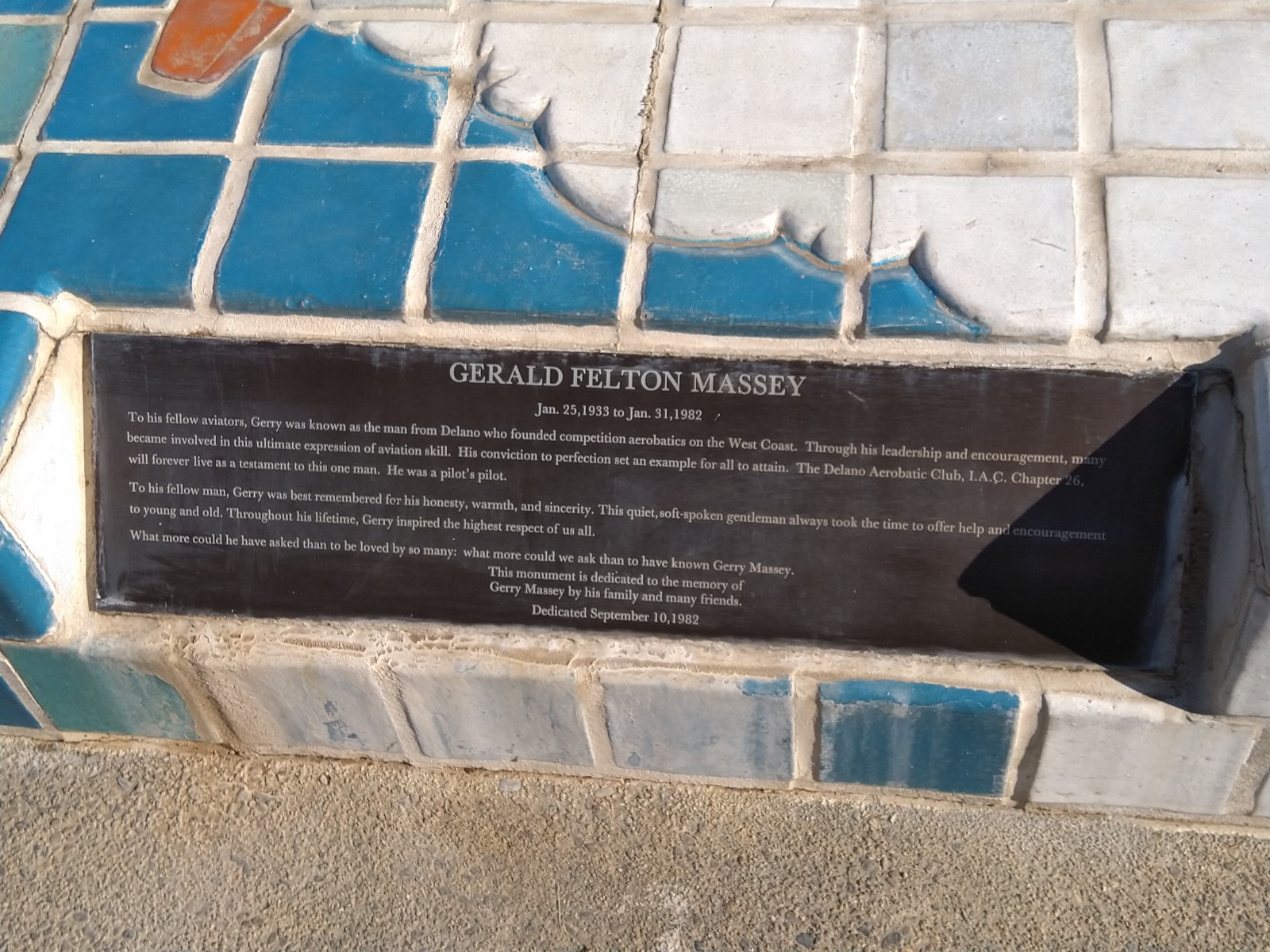
I always like to see local aviators enshrined at their stomping grounds. Delano so honors Gerald Massey.
The casino itself is very much a casino. Inside there is a bar and small restaurant/grill and a bunch of tables. Even a gambling hub is quieter on a Sunday shortly after 11 AM, and The Aviator was no exception. There were two or three at a gaming table and another 3 at the bar. There are always a few people at the bar.
The staff was super friendly, and I chose to have a breakfast sitting at the bar. When I did stick my head into the eating area, it looked more like the cafe at a sports arena or skating ring than a restaurant. That’s not surprising.
The breakfast itself was decent, but again, the focus of the place is gaming, not food. The woman behind the bar was extremely friendly, putting up with my questions and coffee intake cheerfully.
The trip back was similarly pretty but uneventful. A cool day out.
I was horrified to see that a motorist had hit and killed a cyclist along my daily commuting route on Thursday morning. I was further surprised when I realized that I had passed the scene soon enough after the collision that the police were still on the scene and had the street shut down.
I didn’t see the accident, so all I can do is give my sympathies and a few impressions of that area. I’m just going to post those here to contribute what I can to understanding and sympathy.
The Scene
The intersection in question is somewhat challenging, but far from the worst I see on a regular basis. The intersection is treacherous because of the fork and joining of Olive and Manchester. There’s no good way for northbound bike traffic to continue up Manchester without northbound Olive traffic posing a risk. I wasn’t there, so I have no idea if that contributed.
Most of the people I see on bikes in that area are riding simple cruiser kinds of bikes. They look like folks who are making short trips from a bus stop to work or between some of the dispersed work locations – lots of car lots/parking lots there. That also means there are come car carriers and other commercial vehicles in the area regularly that can make it hard to see what’s happening.
Again, my sympathies to the families and friends. Thanks to the indispensable Biking In LA blog for keeping us all aware.
Edward Luce is one of the co-conspirators over at Deep State Radio, a concern I support with some reservations. I picked this up reluctantly. Luce is not my favorite speaker on DSR – that’s probably Rosa Brooks or Kori Schake – and I was concerned that his book would be similarly dry to me. I’m delighted to find him much more sparkling on the page.
Retreat illuminates the state of the world for me in two ways I find useful. It is a powerful and intelligible summation of facts and motivations of liberal ideas in the sense of the sorts of ideas that motivated the creation of the United Nations and other national cooperative bodies (NATO, Marshall Plan). Western leaders planted these after World War II to promote specific values. Luce explicates what these institutions are and what specific ideals the leaders tried to embody in them. The ideals are key to me. We can and should argue about the details of these institutions and how they are implemented, but holding up the motivations and principles that they are intended to promote lets one focus on whether those are worthwhile outside the details of who is behind on their UN dues.
Luce presents those institutions and ideas in the world outside our window, full of mistakes, compromise, and players who don’t believe in either the institutions or the ideals. People who believe in a simplistic world of simple good and evil are woefully unprepared to deal with those very real forces and people. Luce is persuasively and clearly realistic about how the ideas that the WWII winners tried to plant in the ground operate and fail to. He lives in a world where outcomes are not inevitable and invites us to join him.
Beyond that, he writes with clarity, wit, and charm that I was not expecting. While I’m happy to defend that evaluation of his writing, I suspect readers who are less sympathetic to his support of the international institutions will find his style more grating.
Recommended.
Posted in Books, reviews | Comments Off on Review: The Retreat of Western Liberalism
Yeah, I really read this. It’s a novel about DevSecOps. Really.
Intellectually, I understand what Gene Kim, Kevin Behr and George Spafford are up to. They believe in this management and software develop methodology and are trying to evangelize it. What surprised me is that they to spread the word in long form narrative fiction. Evidently they hypothesize that there’s a market for fiction about a Hero’s Journey through software development management.
I pretty much had to read it.
As literature, it’s a total potboiler. (Not that there’s anything wrong with that.) Our hero is thrown into a job he can’t refuse in a department full of underappreciated characters who mistrust him. There are high-level schemers working against his goals and the goals of his company. The security manager takes apparent glee in undermining the smooth operations of systems to defeat imagined foes. Fortunately there’s a guru/guardian angel who embodies nearly every cliche of the misunderstood Silicon Valley genius to take our hero under his wing.
Along the way, our hero quits in frustration, only to be literally begged to come back by the CEO. The security manager walks out, drinks himself into oblivion and comes back to the good side through application of DevSecOps principles. Our hero wins the loyalty of his team, frees his company from the prison of hidebound operating principles and leads it to the Nirvana of market penetration. If you know what I mean, and I think you do.
It’s an advertisement dressed up as an airport novel, executed perfectly competently. For that matter, I learned a few things about DevSecOps management principles that were worth thinking about.
I can’t recommend it, but it’s exactly what it says on the tin.
Posted in Books, reviews | Comments Off on Review: The Phoenix Project
I think Caitlin Doughty makes the world a better place by telling folks what she knows about dying and funeral practices from her perspective as a Funeral Director. She’s admittedly something of a radical and activist director, but I think it’s a fun world in which one can be those things. At her core, she holds death and the rituals and services around it up to the light and tells people how they work. She tells the truth about the nuts and bolts of funerals and burial while respecting the beliefs that drive them.
Will My Cat Eat My Eyeballs? is part of that straight talk campaign. Specifically, she collects questions from children who attend her various appearances, read her books, or encounter her in her day job. In Eyeballs she answers the ones she finds most common, interesting, illuminating, or some combination thereof. I learned a bunch from her answers, and I already knew some about the topics.
She writes clearly, but a little bombastically for my tastes. I do think this is a matter of taste. I feel like she’s performing on paper as much as writing. Words on a page dance different steps than words on a video or podcast. The odd steps never seem more than a mild distraction to me, though. She’s clear and engaging.
Recommended.
Posted in Books, reviews | Comments Off on Review: Will My Cat Eat My Eyeballs?
I heard a strong recommendation for John Helyar’s Lords of the Realm from an excellent baseball commentator, so I grabbed it. I did so with some trepidation. The subject is primarily off-field games – contract negotiations and labor relations – which is usually dead boring to me. I like to sit in the stands and bullshit, not compare player salaries.
I’m pleasantly surprised to report that Helyar brings the evolution of baseball’s labor situation to life very well. He manages to both animate the owners, union founders and leaders, and players. There is plenty of negotiation that feels specific to baseball. He also explains the labor issues clearly and insightfully. Whether you’re like me and love the game more, or a student of the finances, Lords is worth your time.
Recommended.
Posted in Books, reviews | Comments Off on Review: Lords of the Realm