Back to Bakersfield (L45)

March 27th, 2010

I finally had some time this weekend to go out and play in the plane a little. I’ve been meaning to check Bakersfield Municipal out more thoroughly since I stopped by on my last uncontrolled field tour. Today was the day.

The flight out was pretty, but hazy.  Honestly I was surprised at how little traffic was out.  Usually the basin is hopping on the weekends, but there were a couple times today when the radio was quiet long enough that I thought I might have lost comms.  No such luck, though – just quiet.

The other bummer is that I’ve had a cold this week and between climbing over the Gorman pass and descending back into the Central Valley my ears filled right up with phlegm.  Yes, I know this is a charming fact to share with you all.  It hurt a little, but mostly it took me a few minutes to clear them back out so I could hear normally again.

Anyway, Bakersfield is a really well kept-up field.  All the landscaping is pretty and the runway and taxiway surfaces have all been well maintained and, as far as I can tell, recently repaved.  It’s a very pleasant surprise to see such a beautiful little airport.

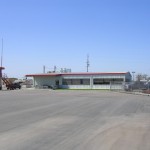
I actually had trouble finding the restaurant.  Despite the fact that the field is really well marked, I missed the building that held the place.  I stopped off on the FBO and a couple folks outside gave me great directions.  Should you ever be looking for the restaurant at Bakersfield, taxi all the way to the departure end of runway 14 and take a left.

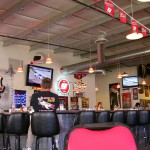
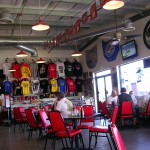
The restaurant itself was unique and interesting.  It wasn’t so much a cafe as a bar with food, but it was a large, well lighted sports bar with a definite bias toward motor sports.  There was plenty of racing gear on display and for sale, and when I sat down the Speed Channel was on.

However, the place didn’t give off the vibe of being a pure sports bar.  It was pretty early in the day when I was there – around 11 – but there were a couple tables of families there and quite a few older couples and groups.  I got much more the feeling of a neighborhood haunt than the young men’s hangout that sports bars often seem to be.

I had a good turkey sandwich, but I probably should have aimed at the burgers, which seem to be a specialty.

Overall it was an excellent experience, and the place could easily become a favorite.  Recommended.

Uncontrolled Field Tour II

December 4th, 2009

As part of tuning up to go east this Christmas, I went out Sunday and did one of my favorite training exercises: an uncontrolled field tour.  An uncontrolled filed is one with no tower to direct traffic, and often no weather information available beyond a windsock at the field (though others have full automated weather broadcast continuously).  While an uncontrolled field is usually less busy than a towered one, they do force the pilot to pay more attention to the world outside the window, knowing that no tower controller will provide another pair of eyes.  Air Traffic Control is also not going to provide traffic advisories or the like in the pattern at an uncontrolled field.  The runways are often shorter and narrower, too.

I did my first tour several years ago when I was feeling uncomfortable about my uncontrolled field radio and pattern entry work, and I reprised it last weekend just to polish that corner of my skill set.  Basically, I go up into the central valley and hop between 8 fields.  Once I’m in the valley, I don’t get flight following, and stay down around 2500′ feet between airports.  I operate primarily by pilotage, and drill those skills as well as pattern entries and uncontrolled radios.

It was a lot easier this time than last.  I think my approach and landing skills have gotten a lot better.  I was much more comfortable getting on and off even the shorter fields in the mix this time.  Here’s a quick recap.

The first field I wanted to hit was a new one for me: Bakersfield Municipal, near the south edge of Bakersfield.  I flew through the Gorman pass and went through some strong up and down drafts.  I lost a couple hundred feet of altitude on more than one occasion by encountering a downdraft that I couldn’t out climb.  I reported them to ATC, but all they can do is warn people.  Once in the Central Valley, the winds eased off, and operations were straightforward.

Bakersfield Municipal from the tiedowns

Bakersfield Municipal from the tiedowns

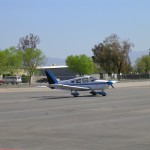
I didn’t stop long at most of the fields, but I did take a picture or two at most.  I took most of them from the cockpit with the plane stopped and the engine running, so the quality isn’t great.  That’s a V-tail Bonanza landing at Bakersfield after I got there.  He was headed for the airport restaurant.  I haven’t been there, but I’ll be back.  The field looks clean and well kept up.

From Bakersfield it was up to Shafter-Minter airport, which I found by following some railroad tracks.  The other times I’ve been to Shafter I’ve seen biplanes in the pattern, including a couple low passes; no such luck today.  You can see some interesting aircraft on the ramp in the picture, though.

The ramp from Runway 12/30 at MIT

The ramp from Runway 12/30 at MIT

From Shafter, more railroad tracks brought me over to Wasco Airport.  This is a little field used primarily by crop dusters, it looks like.  I was pleasantly surprised to hear someone come into the field as I was leaving the area.  It sounded like a student on a cross country.  Here are a few planes on the ramp at Wasco:

Crop Dusters at Wasco

Crop Dusters at Wasco

A Cessna at Wasco

A Cessna at Wasco

From Wasco, it was a short hop over to Delano Municipal, which had a long runway, continuous weather reporting, and a restaurant and helicopter repair shop on the field.  No one was around over there, though, so I made a landing, snapped a shot of a bunch of helicopter fuselages at the repair shop and set out again.

Helos in for repairs at Delano

Helos in for repairs at Delano

The next stop, Porterville, is a favorite airport.  It’s somewhat out of the way, but the food at the restaurant is good, though it has changed hands a couple times.  I planned a stop here for food and gas, but was disappointed.  The restaurant was closed, though I did fuel up, and watch an old Bell helicopter taking some landing practice.

Helicopter practice at Porterville

Helicopter practice at Porterville

Restaurant and Terminal at Porterville

Restaurant and Terminal at Porterville

From Porterville, I started across the valley to Corcoran, a small field used primarily for crop dusting.  It was narrower than most of the fields I hit that day, and very utilitarian.  I always feel like I’m intruding on someone’s workplace when they’ve just stepped out when I come in and out of there, so I didn’t stay long.  As I turned around to leave, I snapped this shot of the AgTractors at rest.

The usual denizens at Corcoran

The usual denizens at Corcoran

The next field on my list was the unattended strip at Lost Hills.  There’s remarkably little at Lost hills, except for a runway and a few tie downs.  I think this is primarily used to bring equipment in and out of the oil drilling sites in the region.  It was easy enough to find from Corcoran by following the 5.  Here’s the windsock (and segmented circle).  As you can see, the sun’s going down, and I really like this picture.  I like how the windsock marks this a point of civilization but feels far from home.

The lonely windsock at Lost Hills

The lonely windsock at Lost Hills

From here, my last stop was Buttonwillow airport, another unattended strip just down the canal from Lost Hills.  I like Buttonwillow much more than I should, partially because I’ve had some cool experiences there.  Today as I was approaching from the north, I heard another aircraft approaching to land, which always surprises me; I always think I’m the only one who knows about Buttonwillow.  It turned out to be a Luscombe, who was straight in.  I let him in ahead of me and took a shot of the setting sun, the Luscombe (the nose is cut off in the thumbnail, but not the full shot), and the runway, which is really getting overgrown a bit.  I really like the runway shot because it again captures the out-of-the way feel of the place.  Try to ignore all the bugs on the windshield.

Sunset at Buttonwillow

Sunset at Buttonwillow

Another pilot at Buttonwillow

Another pilot at Buttonwillow

Runway 11/29 at Buttonwillow

Runway 11/29 at Buttonwillow

From here it was back to SMO in the fading light for a night landing that didn’t count toward currency.  I imagine that this wouldn’t be much fun for most passengers, but I enjoyed a day of picking my way along at a low altitude, getting into and out of small fields and generally just flying.

Instrument Practice

November 25th, 2009

How instrument pilots practice their skills can be confusing to non-pilots (or even to VFR-only pilots).  In mid-October Marc Zorn and I went up and did some practice approaches, and Marc took some great pictures that may help make the process easier to understand.  Here’s a short description of what we did.

First to set the stage, the whole LA basin was under an overcast layer with bases at between 1,000′-1,500′ and with tops between 2,500′-3,000′.  Visibility above and below the layer was excellent.  This means we were on IFR clearances all day, but much of our flying was in VFR conditions.  In fact, when we were above the clouds things looked like this:

Flying above the cloud layer

Flying above the cloud layer

As you can see, as far as keeping the aircraft right side up, these conditions are (almost) as good as a clear day with no clouds at all.  I say “almost” because there are some differences between the cloud deck and a real horizon – a sloped cloud deck can lead to the illusion that the plane’s level when it’s really banked – and because it’s a lot harder to see where the airports are.  In order to practice controlling the plane without reference to the outside clues, the training pilot wears a view-limiting device – usually called a hood – that restricts what he or she can see.  Generally a hood restricts the pilot’s vision to stop at the top of the glareshield (dashboard on a car).  Here I am wearing a hood:

Me under the hood

Me under the hood

While Marc is enjoying that gorgeous view, I’m seeing instruments and gray plastic. But, because I can’t see other airplanes Marc is acting as a safety pilot for me.  That means he’s looking out for other aircraft and letting me know if there’s a situation where I should remove the hood and take action.  Of course if there’s an emergency that happens so fast that it’s safest for him to take control of the airplane, he can do that as well.  We talk through the parameters of that on the ground.  A safety pilot needs to be qualified to fly the aircraft, of course.

While we’re above and below the clouds, I’m under the hood and Marc’s looking around (and taking the occasional picture).  Today we have some time when we’re in real instrument conditions – inside clouds.  When that happens, Marc lets me know and I take the hood off.  Here are a couple shots inside a cloud:

Flying inside a cloud

Flying inside a cloud

The wing in a cloud

The wing in a cloud

That picture inside the plane isn’t photoshopped.  There’s nothing but white outside, and the plane is being controlled entirely by instruments (and me).  You can see the wings, as the second image shows, but without a horizon to reference, that isn’t much help.

For those of you familiar with the LA airspace, the picture inside the plane was taken just as we were joining the localizer for the ILS approach into Oxnard.  The ILS provides vertical and lateral guidance to the airport – that is it tells the pilot what direction to fly to get to the airport and how high to be at any point on the approach.  It’s a precise system. It can guide a plane to within 200′ (altitude) of the runway threshold, from which point you land by eye.  Today the ceilings were much higher, but after breaking out of the clouds I went back under the hood until the 200′ mark.  Inside the clouds the view looks like this (the blur is the propeller):

Looking out the front in a cloud

Looking out the front in a cloud

At around 1000′, we break out and it looks like this:

Breaking out at Oxnard

Breaking out at Oxnard

The runway is the black strip right above the curl in the cowling between the propeller and the oil door.  It’s much easier to see on the larger image.

If we’re flying the approach in real life, we transition mostly to visual flying at this point; while training I go back under the hood.  We land at Oxnard and then filed a flight plan to another airport and do it all again.  Sometimes pilots intentionally miss an approach (in coordination with ATC) to get more approaches in, but I wanted to practice the transition to visual flying through to a landing today.

So that’s a little bit about how instrument training goes.  Marc took all the pictures in this entry, and I downscaled them somewhat, so distortions are my fault.

Lunch at Corona

November 23rd, 2009

It looks like Brenda and I will be flying East this year for the holidays, which means I’ll be finding extra excuses to go out flying this month.  Today’s excuse was a trip out to Corona, a small uncontrolled field out near Chino and Ontario.  Corona strikes me as a good community airfield and it’s usually a good trip, though it does get busy there.

The flight out through the LAX special flight rules corridor was pretty uneventful.  The Inland Empire had some haze in place, but nothing too bad.  I heard some people land at Corona ahead of me, but as I came in, I had the pattern to myself.

I tied down and moseyed over toward the restaurant, and spotted this cool Ercoupe on the way.

Ercoupe at AJO

There are so many cool Ercoupes running around these days that there must be some kind of Ercoupe hot rodder’s club or something.

Anyway, I like Corona because it’s the kind of little field where you can see the planes along the town’s roads near the airport.

Main road at AJO

Of all the things at Corona that I liked in the past, the restaurant made the least impression on me.  It was fine, but I don’t remember it fondly.  And now I’ll have to remember it. A new place has opened up in the old restaurant’s place, called Bobby A’s.  I talked briefly with Bobby when I was there and he says he’s only been open since mid-September.  He should stay open for a while – the food is good and priced reasonably and the place feels like it’s run by people who care.  It’s pretty much a 50’s diner, but there were vegetarian options, and the breakfasts looked good.  I’ll definitely be back.

Bobby A's

On the way out I passed this little vehicle outside the airport security office.  I don’t think I’d mess with a security guard riding it.

Gator Board

As I walked up to the place to move on, I saw this gorgeous Stearman running up and departing.  Boy do I love the old biplanes.

Stearman running up

As I was getting untied and ready to go, I’m pretty sure I saw two planes almost meet in the middle.  A Cessna was in the pattern doing touch and goes arriving behind me and going into the wind.  I saw him land and heard an engine run up, which I assumed was the Cessna following through.  I looked up, though and saw an airplane that was coming toward me and turning right to the downwind. Then I saw the Cessna follow through.

I’m pretty sure they were headed right at each other, though they were never very close.

Not a good thing.

Anyway, I cruised over to Chino and got some landing practice in.  I was going to do a few at Corona, but honestly the pattern was pretty busy, and though some people were ignoring it, there was a sign saying no touch-and-goes on the weekends.  I try to be a good neighbor, so I flew the 2 miles over to Chino.

After a few trips around the patch, I filed an instrument flight plan back to Santa Monica just for the chance to drill procedures and practice working in the system.  The trip back went very well.

I’m looking forward to a few more before the big trip in December.

New Reviews

November 20th, 2009

I have a new set of short reviews up on Bell, Book and Candle, covering Three Cups of Tea, Passionate Declarations, and What Have You Changed Your Mind About?

Upgrade to WordPress 2.8.6

November 20th, 2009

Auto upgrade to 2.8.6 today. That was slick.

Server upgrade for Ylum

October 11th, 2009

Today I finally finished the latest hardware upgrade to ylum, the server you’re probably reading this on.  I’ve been trying to upgrade it in one form or another for a month or a month and a half.  The original goal was to get a FreeBSD gmirror running for backups (along with filesystem snapshots for file recovery).  That required upgrading my hardware because the old cheap motherboard I was using wouldn’t support the SATA disks I was moving to for mirroring.  Then I had another bad bargain basement experience, and a second motherboard with transient lockup problems.  All in all frustrating.

This weekend I stopped by Fry’s and picked up an Intel motherboard and Intel i5 4-core CPU.  Gotta dig the matching boxes:

Matching Boxes

Matching Boxes

The only problem is that I didn’t realize that this board has no parallel ATA controller until I was standing there with nowhere to plug my old disk in.  I was able to use the unreliable motherboard to move my data and OS over to a SATA disk, which just booted and ran on the Intel motherboard.  Not an upgrade path I would recommend, but overall things are pretty good.  FreeBSD doesn’t quite see the onboard ethernet yet, but that should be a minor problem, and I have a legacy PCI ethernet in there now that’s doing fine.  The new ylum internals look like this:

Ylum innards

Ylum innards

There’s some cleanup and tweaking to do, but 4 2.66 Ghz CPUs make software updates fo much faster.  And mirroring should go into use shortly.

Sorry for any inconvenience, and as always we thank you for your support.

Spook Country Capsule

September 28th, 2009

Another short review posted on Bell, Book, and Candle.  This time William Gibson’s Spook Country.

Total Eclipse of the Heart

September 28th, 2009

I know I’ll want to find this flowchart for understanding Total Eclipse of the Heart again. Now anyone reading this can find it again, too.

New Capsule Review

September 14th, 2009

A short review of Freakonomics is up on Bell, Book, and Candle.